
Cinnamon types: which to buy — Ceylon, cassia, Saigon, Korintje
By TMICORP Editorial Team | Last updated: 2026-07-30
This article is for general information only and is not medical advice. Talk to a qualified healthcare professional about your own situation.
1. Quick answer: the main cinnamon types and what decides them
- Ceylon (true) cinnamon is the pick for daily use because coumarin is lowest; it tastes mild and sweet and sits at the premium end.
- Cassia (common/Chinese cassia) is the budget everyday spice with a bold, familiar warmth and the strongest shelf presence.
- Saigon (Vietnamese) cinnamon gives the most intense punch and aroma when you want maximum cinnamon drive in a recipe.
- Korintje (Indonesian) cinnamon is the bakery-friendly cassia many cooks know, smooth and consistent for cookies and spice blends.
Most shoppers think in two buckets — Ceylon as the “true” cinnamon and cassia as a group — but four commercially common kinds are compared below so you can see 2 types vs 4 types in one place.
2. Comparison table (one quick row per cinnamon type)
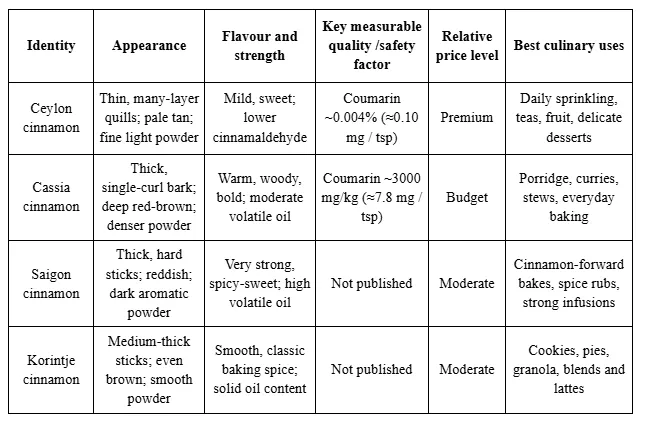
Coumarin levels vary by batch, harvest and grade. Government monitoring places cassia around 3000 mg/kg on average, with some samples much higher, while Ceylon contains only trace coumarin; both are documented in risk assessments and peer-reviewed analyses from the German Federal Institute for Risk Assessment and a medical literature review hosted by the U.S. National Library of Medicine (BfR; NIH/PMC). To judge daily use against a widely used tolerable daily intake (TDI), multiply your body weight (kg) by 0.1 mg coumarin. That equals 6 mg/day for a 60 kg adult and 8 mg/day for an 80 kg adult, a benchmark cited internationally in EFSA-based risk communication (ANSES).
3. How to recognise each type (visual ID with images)
You can tell the different types of cinnamon sticks and powders apart by layers, thickness, color and aroma, even without a label — handy when a pack simply says “ground cinnamon.”
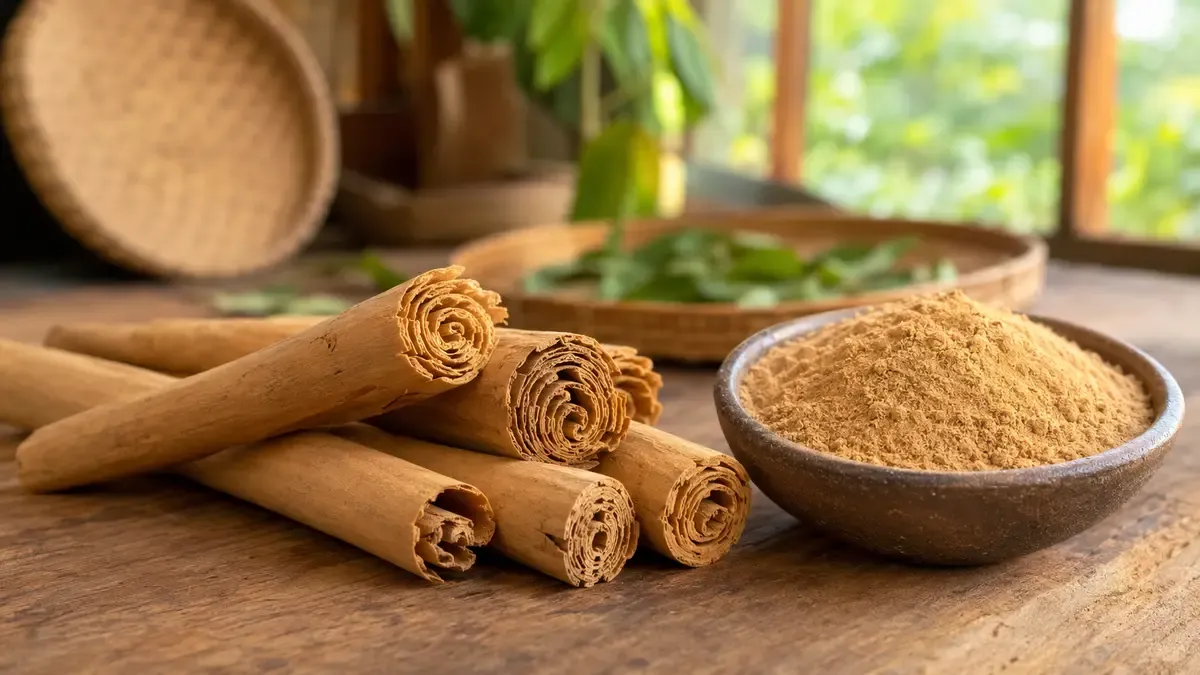
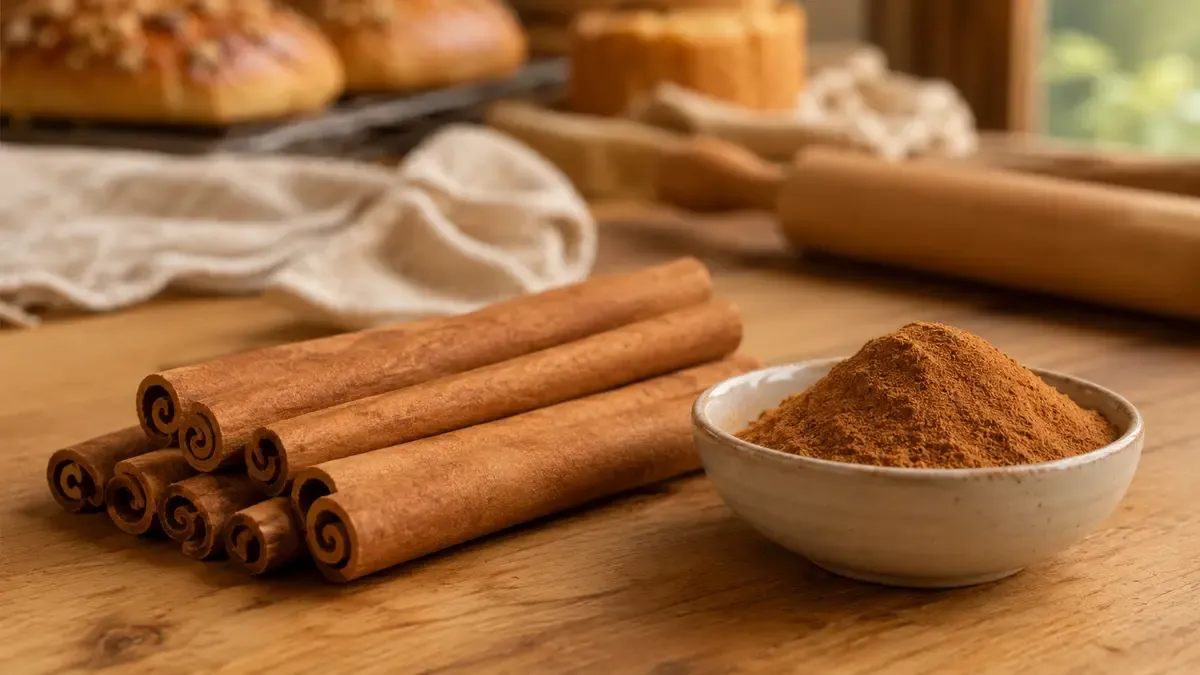
Ceylon (true) cinnamon has quills that are thin and papery with many concentric layers. Color runs pale tan to light brown and the stick snaps easily. The powder is light sandy-tan and fluffy rather than oily. Aroma is sweet, floral and delicate.
Cassia (common/Chinese cassia) shows thick, hard sticks with a single scroll or hollowed tube. Color runs deep reddish-brown. The powder is darker and can feel slightly clumpy or oily. Aroma is robust, warm and woody.
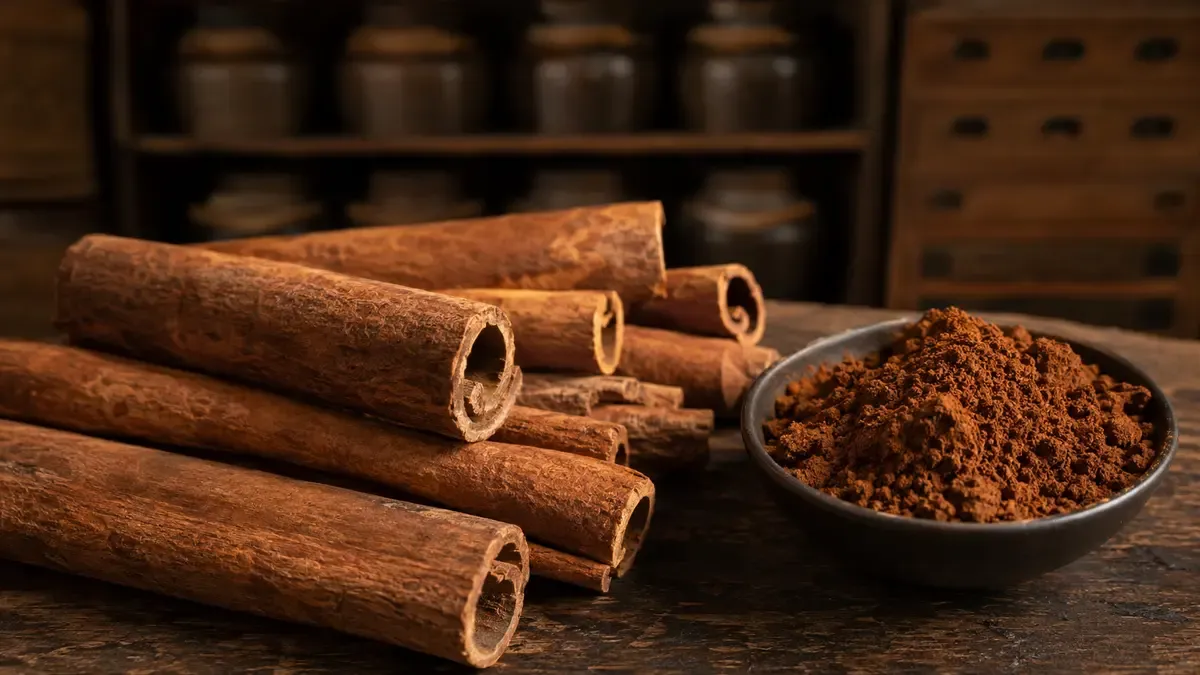
Saigon (Vietnamese) cinnamon presents thick, dense sticks, often a vivid red-brown, with a sturdy single roll in end view. Powder is dark and very fragrant. Aroma leaps out of the bag: spicy-sweet, hot, almost peppery.
>>> See more on: Cinnamon from Vietnam: Saigon & Vietnamese Cassia
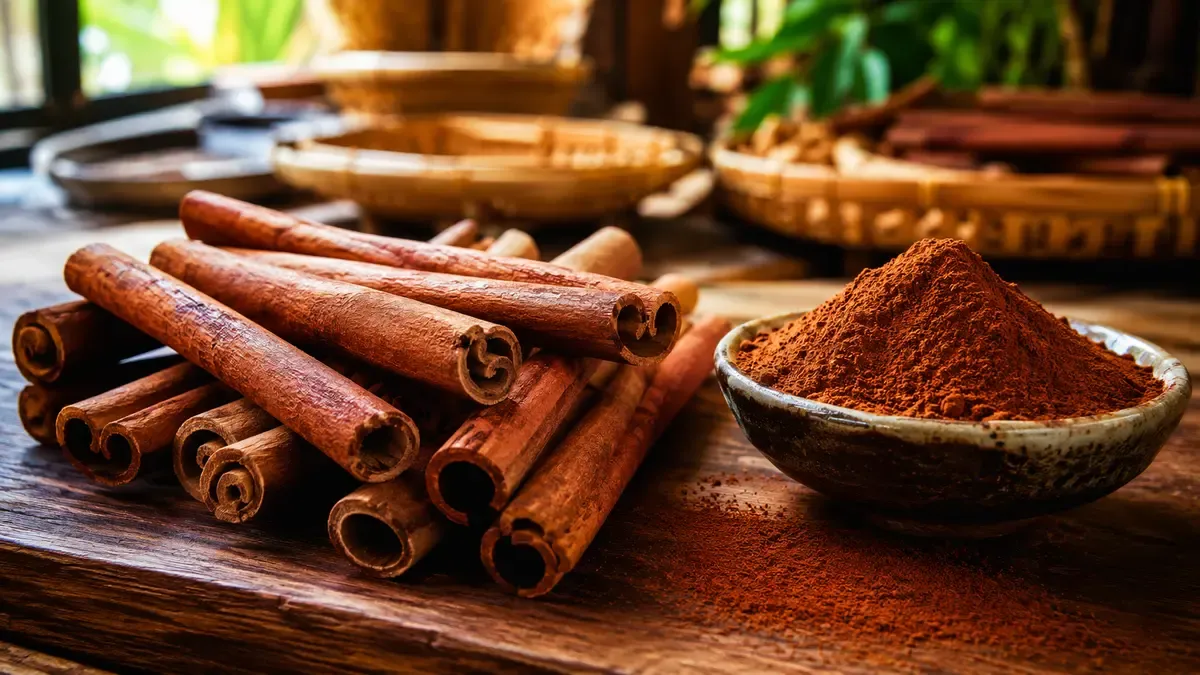
Korintje (Indonesian) cinnamon has medium-thick sticks with a smooth outer bark and even brown color, usually a single, neat curl. Powder is uniform medium-brown. Aroma is classic “bakery” cinnamon, rounded rather than sharp.
Fast shelf tests
- Check the end view: many thin layers signals Ceylon; one thick wall or a single curl signals a cassia type.
- Try a gentle snap: Ceylon breaks crisply; cassia resists and may splinter.
- Smell the jar: gentle sweet suggests Ceylon; strong hot-spicy suggests cassia.
4. Forms and culinary form differences: sticks, quills, chips and powders
Whole sticks (quills) suit infusions and long simmering because they release flavor slowly and taste milder at the same weight. Ground cinnamon is convenient, disperses evenly in doughs and rubs, and delivers roughly 1.5–2× more flavor per gram than using Ceylon sticks because the larger surface area releases volatile oils faster. Swapping kinds? Cut Saigon to two-thirds or half the amount of Ceylon to keep intensity in check, or use about 1.5–2× Ceylon when replacing Saigon to reach similar strength. Use chips or broken quills like sticks for mulling and stews, then strain.
5. Health, benefits and safety: what the science says (and what it means for daily use)
Cinnamon contains antioxidants and is studied for effects on blood sugar, but evidence is mixed and it isn’t a treatment. For everyday safety, the measurable to shop by is coumarin concentration. Ceylon sits around 0.004% coumarin (≈0.10 mg per teaspoon). Common cassia averages about 3000 mg/kg (≈7.8 mg per teaspoon), with some samples higher. A widely used tolerable daily intake (TDI) for coumarin is 0.1 mg per kg body weight per day — for example, 6 mg/day at 60 kg or 8 mg/day at 80 kg — summarized in international risk communication based on EFSA’s assessment (ANSES).
In practice, occasional baking with any cassia is fine, but daily or supplement-level use favors Ceylon because its per-teaspoon coumarin is negligible relative to that TDI. People with liver disease, those who are pregnant, or anyone on medications that affect the liver should be cautious and seek medical advice. For broader context on natural coumarins and dose considerations, see a recent pharmacology review (Frontiers in Pharmacology).
6. Local names, language variants and 'dalchini'
Labels reflect many local names. Dalchini is a common South Asian name for cinnamon but doesn’t guarantee species. Ceylon, true cinnamon or canela de Ceylán usually indicate Cinnamomum verum (also called Cinnamomum zeylanicum). Cassia, Chinese cinnamon or ròuguì typically mean a cassia species such as C. cassia. Saigon or Vietnamese cinnamon points to C. loureiroi, while Korintje or Indonesian cinnamon points to C. burmannii. In German, zimt is the generic word for cinnamon and on its own often refers to cassia. If a pack just says “ground cinnamon,” many markets use a cassia type by default.
7. Botany: the Cinnamomum species behind your spice
Cinnamon is the inner bark of evergreen trees in the genus Cinnamomum. The four kinds of cinnamon sticks and powders here match to four species: Cinnamomum verum (Ceylon; synonym C. zeylanicum), C. cassia (common cassia), C. loureiroi (Saigon/Vietnamese) and C. burmannii (Korintje/Indonesian). These trees differ in essential-oil profile and in how much coumarin they produce, which is why their aroma strength and suitability for daily use differ.
8. What to check when buying (shopper checklist)
1) Read the name on the label and distinguish “Ceylon” or “true cinnamon” from “cassia” or regional names like Vietnamese/Saigon or Korintje.
2) Choose the form you need — whole quills or ground — and check the ingredient list shows a single spice, not a blend.
3) Confirm origin/species: Sri Lankan origin or Cinnamomum verum indicates Ceylon; Vietnam/Indonesia/China often indicate cassia types (C. loureiroi/C. burmannii/C. cassia).
4) Use appearance cues: thin, multi-layer pale quills point to Ceylon; thick, dark, single-curl bark points to cassia.
5) Do a smell check if possible: sweeter, delicate aroma suggests Ceylon; stronger, spicier suggests cassia.
6) Inspect packaging: sealed, dry, with no clumping in ground spice.
7) Check date codes and pick recent production or best-before for freshness.
Mislabeling can happen. If you need low-coumarin for daily use, buy packs explicitly labeled “Ceylon (Cinnamomum verum).”
9. Storage and next steps: pick, store and use
If you use cinnamon daily in tea, smoothies or at supplement-like amounts, choose Ceylon for its trace coumarin and gentle flavor. For occasional baking or bold recipes, pick a cassia: Saigon for maximum punch, or Korintje for familiar, rounded bakery notes. Ceylon typically sits at the premium end and may show up more with specialty sellers; cassia types are widely available, with Saigon often positioned between.
Store cinnamon airtight, away from heat and light. Whole quills retain aroma longer than ground; keep ground cinnamon in small jars, tightly closed, and replace every 6–12 months for best flavor. Keep sticks dry and use clean, dry spoons. Next shop visit, if you want low-coumarin daily cinnamon, look for Cinnamomum verum on the label and check the end view of a quill for many thin layers.
10. Frequently asked questions
What is the difference between Ceylon and cassia cinnamon?
Ceylon is milder and contains only trace coumarin, while cassia is bolder and typically much higher in coumarin. For daily use, Ceylon is the safer long-term choice.
Which cinnamon is safest for everyday use?
Ceylon (Cinnamomum verum) because its coumarin is about 0.10 mg per teaspoon, well below the commonly cited TDI for most adults.
How can I tell Ceylon sticks from cassia sticks?
Look at the end: Ceylon shows many thin layers and snaps easily; cassia is a single thick curl and feels hard and dense.
Does “dalchini” mean Ceylon or cassia?
Dalchini is a common name for cinnamon and doesn’t guarantee species. Look for “Cinnamomum verum” or “Ceylon” on the label if you want the low-coumarin type.
How should I store cinnamon to keep it fresh?
Keep it in an airtight container in a cool, dry, dark place; use small jars for ground cinnamon and replace it within 6–12 months.


Related Articles
Canned Pineapple Benefits: Health, Nutrition & Risks
WHAT IS CANNED PINEAPPLE?
3 Easy and Delicious Dishes You Can Make with Canned Pineapple
Discover 8 of the Best Bubble Tea Flavors Around the World!